
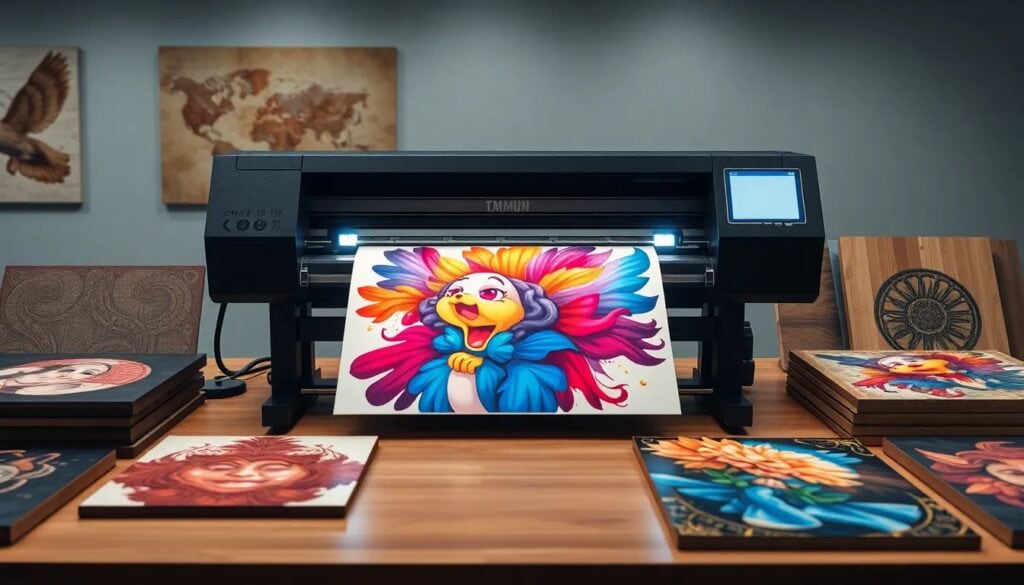
A wall sign, a trade-show panel and a decorative plaque may use similar artwork but require different substrates. Printing on rigid materials produces graphics on panels with different weights, thicknesses, surfaces and resistance.
Before choosing foam board, PVC, acrylic or aluminium, determine where the piece will be installed, how it will be fixed and how long it will be used.
When choosing rigid media: assess weight, indoor or outdoor use, installation, thickness and compatibility with the printing process.
What does direct printing on rigid media mean?
The image is applied directly to a compatible panel rather than being printed on adhesive vinyl and mounted afterwards. For other projects, mounted vinyl may be preferable; the two processes produce different results.
The available method depends on the equipment and required finish.
Foam board: lightweight and suited to interiors
This lightweight material is common in presentations, exhibitions and temporary applications. Impact and moisture resistance vary by product. Not every board is suitable for outdoor use.
Acrylic, foamed PVC and aluminium composite
Acrylic
It can be used for display and decorative pieces. Printing method, transparency and placement substantially change its appearance.
Foamed PVC
It is used for certain signage and visual-communication panels. Assess rigidity, thickness, environment and installation.
Aluminium composite
It is common where greater panel rigidity is required. Outdoor performance and fitting options depend on the exact product.
Quick substrate comparison
| Substrate | Common application | What to check |
|---|---|---|
| Foam board | Indoor presentations and exhibitions | Fragility and moisture |
| Acrylic | Decoration and plaques | Transparency and fitting |
| Foamed PVC | Signage | Thickness and environment |
| Aluminium composite | Panel graphics | Rigidity, installation and specification |
How to prepare the artwork
- Define the cut dimensions.
- Check the effective resolution of photographs.
- Use vectors for logos and text where possible.
- Confirm holes, spacers, rounded corners or special cuts.
- Validate the fixing system before finalising the artwork.
Printing, lamination and installation
Finishes can protect the graphic or change its gloss. For façade installation, assess wind, fixings and exposure as well as print quality.
Explore our large-format printing options for rigid-panel production.
Frequently asked questions
Can acrylic be printed directly?
Compatible systems exist, but artwork and equipment must suit the material and desired result.
Is direct printing better than mounted vinyl?
That depends on the piece, its use, expected life and finish.
Can every rigid substrate be used outdoors?
No. Check the panel, print and installation specifications.
Are you preparing a printed project? Tell us the format, quantities and location so we can assess production.
This post is also available in:
 Français (French)
 Português (Portuguese (Portugal))
 Español (Spanish)