
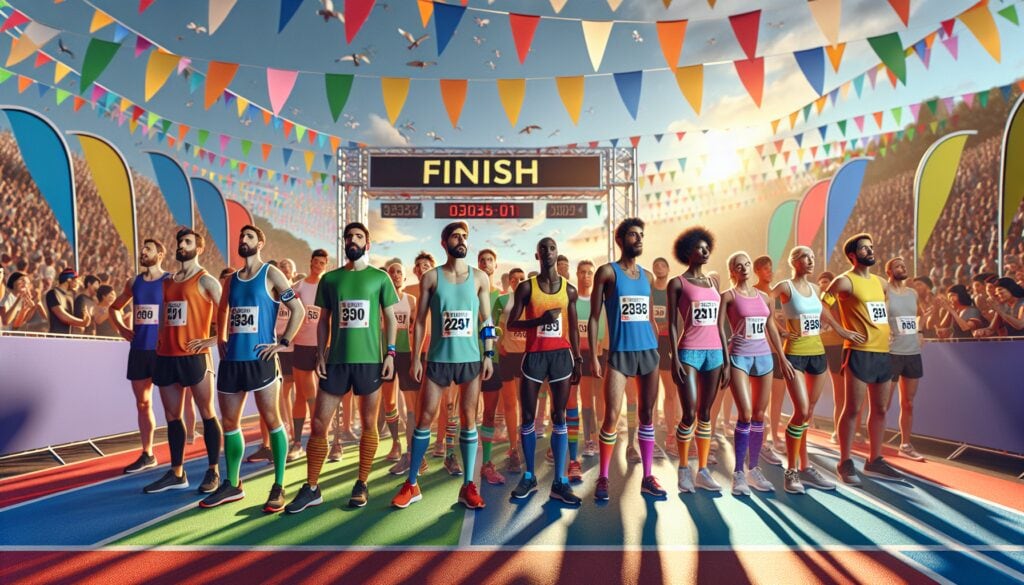
When organising hundreds of race entries, printing the bibs is part of a larger data-management task: every number must match its participant, sponsors must remain legible and the material must withstand the conditions on the course.
Race bibs can include variable numbering, the participant’s name, a code or an identifier for timing systems. Preparation requires checking both the design and the data.
What information should a race bib contain?
The runner’s number is the main element. Depending on the event, the bib may also show a name, category, sponsors and instructions. Avoid overcrowding it to the point that identification becomes difficult from a distance.
If the event uses timing chips or tags, coordinate their position with the timing-system provider.
Papers and materials for race bibs
For races involving rain, sweat or prolonged use, choose a substrate with suitable resistance to moisture and handling. Synthetic papers and specialist products are available; branded materials such as Pretex have properties that must be checked on the data sheet for the specific grade.
Do not assume that every heavy or laminated paper is waterproof.
Variable numbering and data
- Prepare a file containing unique identifiers.
- Check for duplicates and missing numbers.
- Define the numbering format and categories.
- Confirm whether names or other personal data will be printed.
- Generate a proof using the shortest and longest numbers.
- Approve the final list before production.
Choosing the size and attachment method
Dimensions depend on the event and the organiser’s instructions. Allow room for holes, safety pins or other attachments without compromising readability or participant data.
Bibs with sponsors and codes
| Element | Check |
|---|---|
| Number | Contrast and readable size |
| Sponsor | Correct logo version |
| Code | Real scanning test |
| Chip | Position and timing-system compatibility |
Common race-bib printing mistakes
A numbering error can cause more disruption than a small colour variation. Also check that no important element will be covered when the bib is attached.
Participants’ personal data requires an appropriate handling procedure and a clear decision about what information should be publicly visible.
When every bib contains a different number or detail, use a controlled variable-data workflow and verify the merged output before production. Tickets and admission materials for the same event should follow a similarly checked numbering system.
Frequently asked questions
Can each bib have a different name?
Yes, using variable-data printing compatible with the production process.
Are all race bibs waterproof?
No. Select a substrate intended for the expected conditions.
Can a QR code be added?
Yes, provided its size and reproduction allow reliable scanning in real use.
Do you have an event-printing project? Tell us the format, substrate and expected quantity so we can assess production requirements.
This post is also available in:
 Français (French)
 Português (Portuguese (Portugal))
 Español (Spanish)