
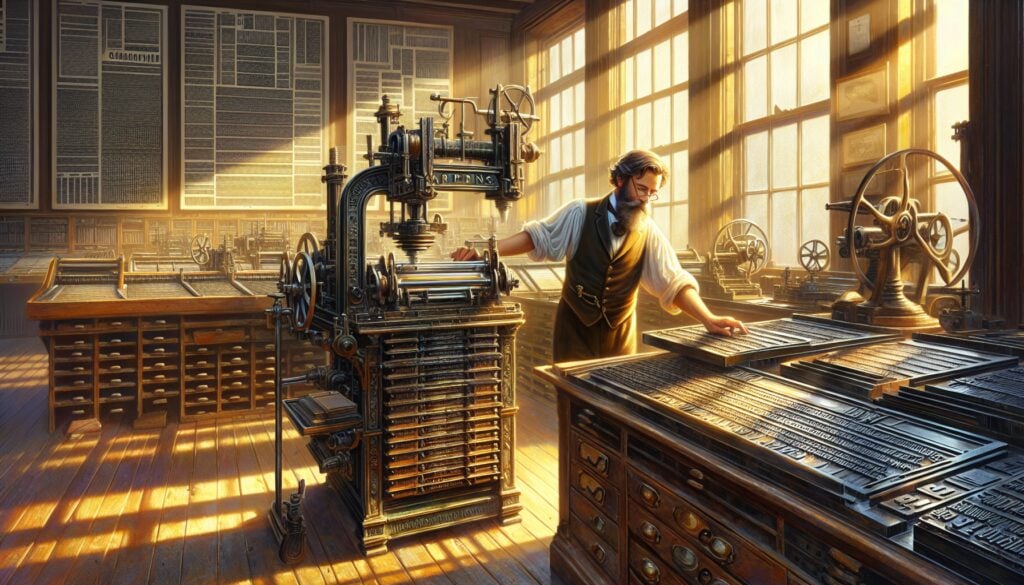
Linotype transformed industrial typesetting by mechanising the production of complete lines of text. It is associated with Ottmar Mergenthaler and the expansion of the newspaper press in the late nineteenth century. Although typesetting is now digital, understanding this technology helps explain how newspapers and books were produced before computers.
Linotype cast a line of text as a single metal piece, unlike systems that worked with individual characters.
Who was Ottmar Mergenthaler?
Mergenthaler was a German-born inventor who worked in the United States and became known for developing a typesetting machine that improved productivity in print shops and newspapers. His work became established during the 1880s.
What does Linotype mean?
The name comes from the idea of a “line of type”. The machine could compose and cast complete text lines as metal pieces known as slugs.
How did the machine work?
The operator entered text on a keyboard. Matrices were assembled to form a line, spacing was adjusted and molten type metal was cast to produce a printing block. The matrices could then return to the magazine for reuse.
What was type metal?
Hot-metal composition used purpose-made alloys containing materials such as lead, antimony and tin. Handling them involved the safety requirements associated with metal casting.
Linotype versus Monotype
| System | Unit produced | Approach |
|---|---|---|
| Linotype | Complete cast line | Rapid text composition |
| Monotype | Separate characters in certain systems | Composition offering different correction flexibility |
Why was it important to newspapers?
Mechanisation enabled large quantities of text to be composed with less manual work per line. Newspapers could prepare pages far more efficiently than with character-by-character composition.
The move to phototypesetting and computers
During the twentieth century, new methods gradually replaced metal composition. Phototypesetting and later digital systems completely changed the process.
What survives from that period?
Printing and book-arts museums preserve machines, tools and historical records. Madrid’s Municipal Printing Museum is an important place for learning about traditional graphic processes.
Frequently asked questions
Did Linotype print directly onto paper?
No. Its main function was to compose type for subsequent printing.
When was it developed?
During the 1880s.
Is it still used?
Mainly in historical, educational or specialist contexts.
Do you need to print a book or catalogue? Send us the page count, dimensions, material and binding requirements.
This post is also available in:
 Français (French)
 Português (Portuguese (Portugal))
 Español (Spanish)