
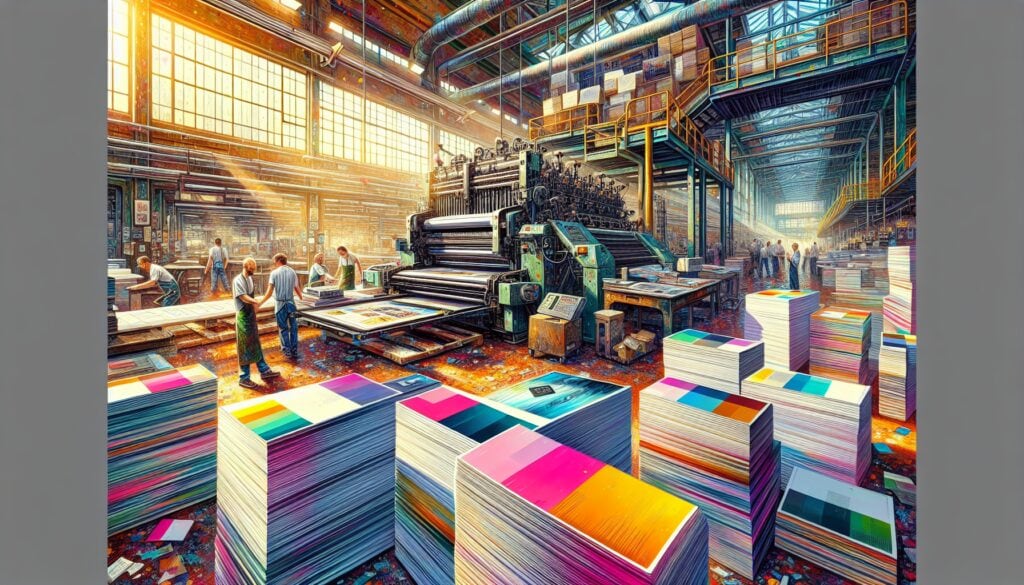
When a printer suggests Offset paper, this does not necessarily mean that the job will be produced on an offset press. The term describes a family of uncoated papers with a natural surface, commonly used for books, notebooks, forms and corporate stationery.
The choice matters: a novel needs comfortable reading, a photographic catalogue may benefit from another surface, and a form needs paper that accepts writing. The practical differences below will help you decide.
Quick answer: offset paper is generally uncoated, has a matt finish and is available in different weights and shades. It can be printed using various compatible technologies; its name does not require offset lithography.
What is offset paper?
It is paper without the coating used to alter the surface of coated stocks. Depending on its manufacture, it can have different levels of smoothness, whiteness and opacity. Ink interacts with it differently from a coated surface, which affects photographs and solid colour areas.
It is not automatically recycled or inexpensive paper. Products are available at different quality levels and in white or cream shades; their composition and certifications must be checked in the manufacturer’s technical data.
Types of offset paper
White offset paper
This is a common choice for letterheads, documents, notebooks and book interiors. Its shade and whiteness vary between products.
Cream offset paper
It has a warmer tone and is often used for text-led publications. Choose it by comparing the shade, weight, opacity and thickness required for the book.
Recycled or certified offset paper
A particular stock may contain recovered fibre or carry forest certifications, but neither property can be inferred from its colour. Check the supplier’s specific claims.
Offset paper versus coated paper
| Property | Offset | Coated |
|---|---|---|
| Surface | Usually natural and matt | Coated; matt, silk or gloss |
| Text and writing | Common for reading and annotation | Suitability for writing depends on the exact stock |
| Photography | May look less intense or more absorbent | Surface designed to control certain details more closely |
| Selection | Prioritise feel, readability and use | Consider visual reproduction and finish |
Coated paper is not always better than offset paper. The correct choice depends on the product’s use and visual style.
Weight, opacity and thickness
Paper weight expresses mass per square metre; it is not a direct measurement of thickness. For a book, also check opacity, bulk and actual thickness, particularly when calculating the spine.
If images are printed on both sides, insufficient opacity may allow the opposite page to show through. A printed sample is more informative than a single specification figure.
Uses in business and publishing
- Textbooks and novels: white or cream reading pages.
- Notebooks and manuals: sheets for writing or reference.
- Letters and forms: corporate documents that may be completed by hand.
- Brochures: natural-looking pieces whose design does not depend on large full-colour photographs.
For text-led publications, explore our book printing options; for company documents, see our brochure and paper printing service.
How to choose a paper for your project
- Decide whether text, photographs or handwriting is the priority.
- Compare white and cream samples when shade matters.
- Confirm the weight, thickness and opacity.
- Check compatibility with the press and intended finishes.
- Request a proof when reproduction or feel is critical.
Not every product marketed as paper has the same composition. Always consult the technical data when a material uses mineral content, recovered fibre or a specialist coating.
Frequently asked questions
Can offset paper be used for digital printing?
Many stocks can, but compatibility depends on the machine and exact paper. Check the equipment specification.
Can you write on offset paper?
It is generally suitable for writing, although the intended pen or pencil should be tested.
Is offset paper the same as 80 gsm paper?
No. Offset describes a paper family; 80 gsm is one possible weight among many.
Do you have a printing project? Tell us the format, paper, quantity and intended use so that the most suitable options can be reviewed.
This post is also available in:
 Français (French)
 Português (Portuguese (Portugal))
 Español (Spanish)