
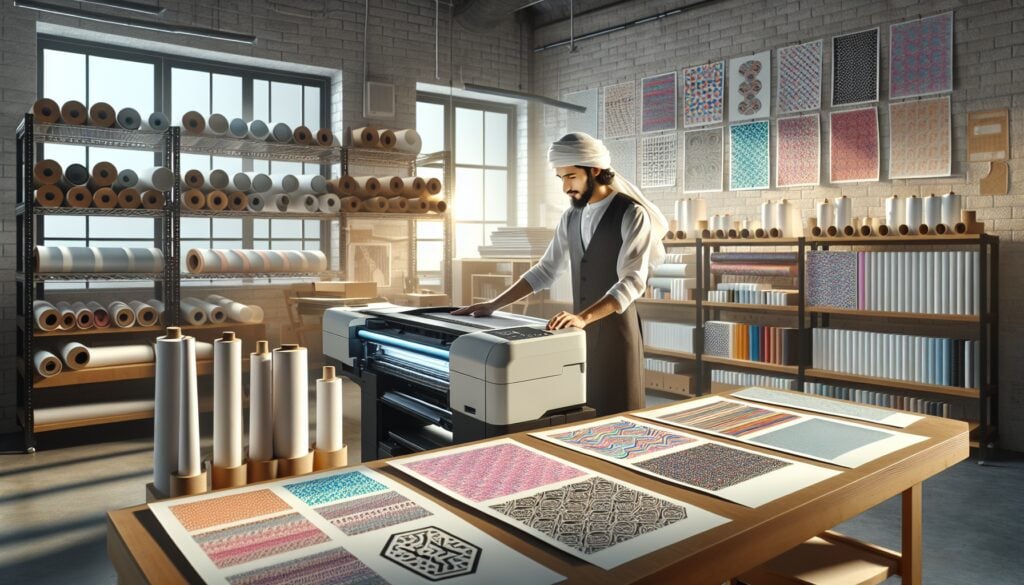
A photograph printed in a magazine appears to contain continuous changes in colour. Under a magnifying glass, however, it is made up of many tiny dots. The way these dots are arranged is called halftone screening, and it is fundamental to reproducing highlights, shadows and intermediate tones in print.
Several screening systems are used in graphic production. AM and FM screening are among the best known: AM mainly varies the size of dots placed on a regular grid, while FM uses small dots whose distribution and concentration change to create different tones. Hybrid systems also exist.
The difference in one sentence: AM screening changes dot size; FM screening mainly changes dot distribution and concentration. The choice depends on the printing conditions, substrate and image.
What is a halftone screen?
A press cannot reproduce a photograph by applying an unlimited number of ink intensities to every millimetre. Instead, it simulates tones with a pattern of dots. Viewed from a normal distance, those dots blend visually and create the appearance of continuous tone.
In multi-colour printing such as CMYK, the result also combines separate colour channels. Their setup affects definition, gradients, texture and possible visual defects. Screening is only one part of the process: file preparation, plates or printheads, ink and paper also matter.
AM screening: variable dot size on a regular grid
AM stands for amplitude modulation. In conventional screening, dots remain in a periodic arrangement while their size increases or decreases to represent darker or lighter areas.
Light areas use less ink coverage and dark areas use more. Important parameters include screen ruling, usually expressed in lines per inch, and the screen angle assigned to each colour separation.
Advantages and limitations of AM screening
AM is well established in Offset printing and suits many editorial and commercial jobs. Its behaviour is predictable in a properly controlled workflow. However, overlapping periodic grids can create visible patterns or interference if angles, frequencies and colour separations are not correctly managed.
FM screening: small dots with variable distribution
FM stands for frequency modulation. Rather than creating tones primarily by changing dot size on a regular grid, it changes the concentration and position of small dots. It is also known as stochastic screening, although the algorithms are not necessarily purely random.
This method can reduce certain periodic patterns and reproduce fine detail when the press, paper and production controls support it. It does not automatically guarantee better quality: dot stability and substrate behaviour require careful control.
AM, FM and hybrid screening compared
| Aspect | AM | FM |
|---|---|---|
| How tone is created | Mainly by varying dot size | By varying the distribution and density of small dots |
| Arrangement | Periodic grid | Non-periodic or less regular pattern |
| Typical parameters | Ruling, angles and dot shape | Dot size and distribution algorithm |
| What to monitor | Moiré, rosettes and tonal reproduction | Grain, dot stability and substrate reproduction |
| Selection | Depends on the job and print process | Depends on the job and print process |
Hybrid screens combine features of both methods for particular reproduction needs. No setup is universally superior. A higher screen ruling will not improve the result if the press or paper cannot reproduce it consistently.
What is moiré and why does it occur?
Moiré is an interference pattern that can become visible when periodic structures overlap. It may occur between colour separations or when reproducing photographs that already contain halftone dots, fabrics or repeating lines.
Prepress workflows reduce this risk by controlling angles, rulings and, where appropriate, the screening method. Not every visible texture is caused by an incorrect screen angle, so moiré should be distinguished from other print defects.
When printing scanned magazine images: check whether the original already contains a halftone pattern. Rescreening a previously printed image can create new interference.
Halftone screening in offset printing
Screening forms part of the image preparation used to make the plate. In offset printing, selecting and controlling the screen helps maintain consistent reproduction in illustrated books, magazines, catalogues and promotional material.
Quality depends on more than the choice between AM and FM. Dot gain, ink behaviour, coated or uncoated paper, calibration and colour control all influence the result.
What about digital printing?
Digital presses use their own halftone technologies, screening algorithms and internal controls. They do not all behave like an offset press, and screen settings should not simply be transferred from one process to another.
For digital printing, prepare images correctly and follow the supplier’s specifications. Screening is normally handled by the printing system and its raster image processor.
What should a designer check?
- Effective image resolution: it must suit the reproduction size and printing process.
- Previously screened originals: take care with scans from earlier printed pieces.
- Colour and profiles: follow the printer’s workflow.
- Very fine detail: check lines, gradients and textures that may lose definition.
- Proofs: request them when colour or fine-detail reproduction is especially critical.
Practical advice: you normally do not need to apply a halftone screen manually to photographs in the final PDF. Prepress or the printing system handles it. Ask the printer before modifying an image.
Frequently asked questions
What is an AM screen?
It is a halftone system that represents tonal changes mainly with different-sized dots arranged on a periodic grid.
What is an FM screen?
It represents tones with small dots distributed at varying densities, without the conventional periodic grid.
What is the difference between screening and resolution?
Screening describes how tones are represented with dots; resolution describes the detail contained in an image or reproduced by a device.
Is FM always better?
No. It can benefit certain jobs but requires a compatible, well-controlled production process.
Are screens used for text?
Solid black text is normally reproduced as a solid element. Screens are primarily used for tints, halftones, images and tonal graphics.
Preparing a publication with demanding photographic detail? Tell us the format, paper and expected print run so that we can assess the production conditions.
This post is also available in:
 Français (French)
 Português (Portuguese (Portugal))
 Español (Spanish)